GS1 Digital Link vs QR Code: What Brands and Printers Need to Know Before Sunrise 2027
By the end of 2027, retailers plan to be able to accept 2D barcodes at point of sale, and 48 countries covering 88% of global GDP are already piloting the migration. Large retailers are already communicating timelines to their suppliers. And yet, as brands and printers scramble to get ready, the same misunderstanding keeps derailing their compliance efforts. They create a QR code. But they don’t create a GS1 Digital Link QR code. Those are not the same thing.
What is a standard QR code?
Unitag tracks 2.4 million scans daily across 189 countries. Over 40 million QR codes generated for brands including Bonduelle, Schneider Electric, and L’Oréal.
A standard QR code is a 2D matrix symbol that encodes a string of data, most commonly a URL. Scan it, and your smartphone opens a web page. The destination is fixed at the time of creation. Standard QR codes have been enormously useful for marketing campaigns, menus, event check-ins, and promotional landing pages. But they carry a fundamental limitation: they encode one URL, they go to one place, and that URL is permanent.
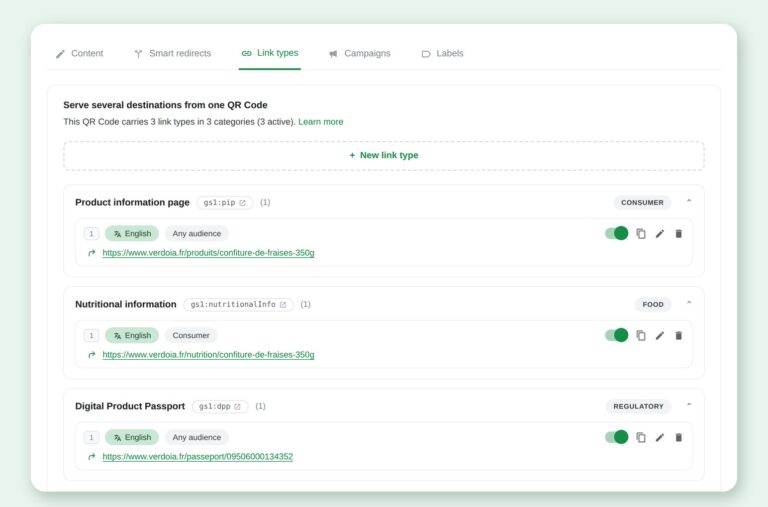
For a world where the same product QR code needs to route a consumer to a product page, a logistics scanner to an ERP lookup, a POS system to a GTIN, and a regulator to a Digital Product Passport, a standard QR code simply isn’t built for the job. The structured routing that modern supply chains require isn’t something you can bolt on afterwards.
What is GS1 Digital Link?
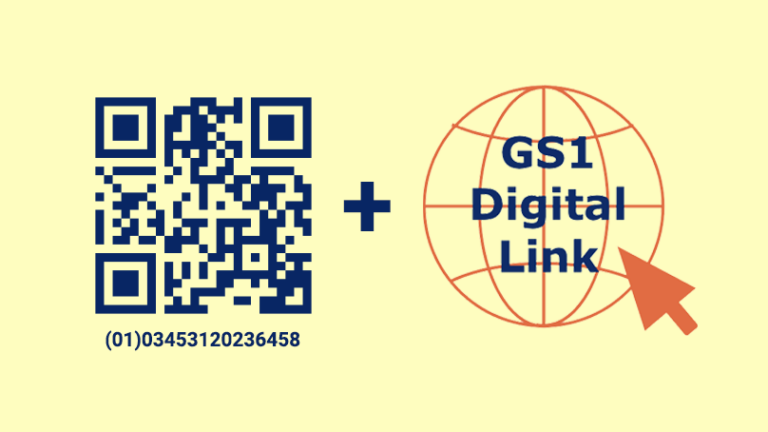
GS1 Digital Link is a web URI standard developed by GS1, the global authority on supply chain standards, the same body behind barcodes, GTINs, and EAN/UPC QR codes. It defines how GS1 identifiers, primarily the GTIN (Global Trade Item Number), can be expressed as a structured web address.
A GS1 Digital Link URL follows a defined structure. Take this example: https://resolver.example.com/01/05060123456783/10/ABC123?17=261231. Breaking that down: 01/05060123456783 is the GTIN, 10/ABC123 is the lot or batch number, and 17=261231, carried in the query string rather than the path, is the expiry date. See how a GTIN is written in a GS1 Digital Link URI for the 14-digit form and its check digit. All of this structured data is encoded inside a QR code. When scanned, a conformant resolver interprets the URI and routes the scan to the right destination, and it can route differently depending on who is scanning and why.
The resolver: the component everyone misses
This is where most companies run into trouble. They generate a QR code with a GS1-formatted URL. They print it on packaging. They consider themselves compliant. They aren’t.
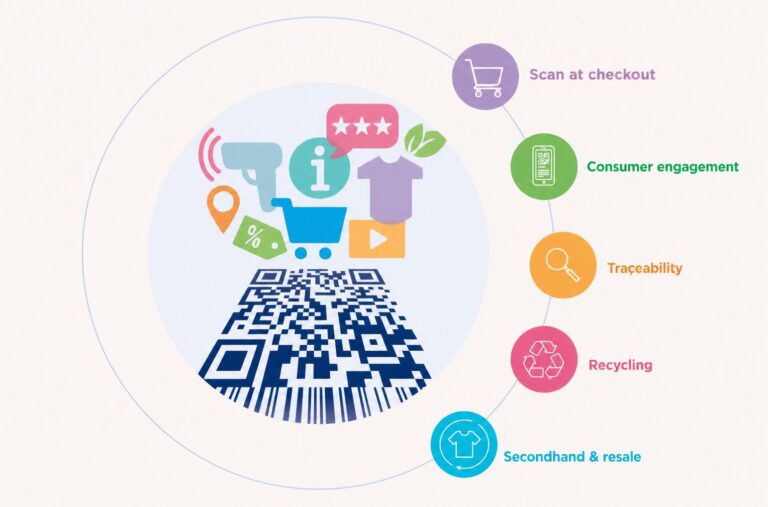
A GS1 Digital Link QR code without a resolver is just a link to a URL. The intelligence, the part that makes it genuinely useful in the field, lives in the resolver. A conformant resolver is what enables a supermarket POS scanner to extract the GTIN and process the transaction. It’s what allows a consumer’s smartphone to open a product page, sustainability data, or recall notice. It’s what gives a logistics scanner access to batch and expiry data, and what lets a regulator or auditor pull up the full Digital Product Passport.
GS1 released Conformant Resolver version 1.2.0 in January 2026. Any platform you choose for GS1 Digital Link should be tested against this specification before you go anywhere near a print run.
Why this matters for Sunrise 2027
Sunrise 2027 is GS1’s global initiative to transition retail checkout infrastructure from 1D barcodes, the UPC/EAN QR codes on almost every product today, to 2D barcodes, primarily QR codes and Data Matrix. The target date is 31 December 2027. After that date, retailers will expect 2D barcodes on packaging. Many are already requiring it from suppliers ahead of schedule.
For brands and manufacturers, this means your QR code must encode the GTIN rather than just a marketing URL. It must follow the GS1 Digital Link URI syntax. It must connect to a GS1-conformant resolver that routes scans correctly. And dynamic QR codes are strongly recommended so the destination can be updated without reprinting.
The GS1 UK and Tesco pilot, with two years of live retail data shared at the 2026 GS1 Global Forum, showed that scale and reliability at checkout depend on strict GS1 Digital Link conformance. Half-measures fail at POS. That’s not a theoretical risk; it’s what the pilot data showed repeatedly.
Why this matters for the EU Digital Product Passport
The EU Digital Product Passport (DPP) is a regulatory requirement under the Ecodesign for Sustainable Products Regulation (ESPR). It mandates that products sold in Europe carry a scannable data carrier linking to structured, verifiable product data. The ESPR set July 2026 as the date for the EU DPP registry, and the first product categories are being prepared.
Batteries are the first category with a passport obligation, from February 2027 under the Battery Regulation. Iron, steel, and aluminium follow, with a delegated act published April 2026 and compliance required by October 2027. Textiles and footwear are next in line, with the delegated act and compliance date still to be confirmed. Tyres and electronics are in the next wave. If your products are sold in Europe, the question isn’t whether you need a DPP-compatible data carrier, it’s whether your current QR code setup can actually support it.
A GS1 Digital Link QR code connected to a conformant resolver is the approach most closely aligned with the EU DPP framework. A standard QR code pointing to a marketing landing page won’t satisfy the regulation, regardless of how it looks on the packaging.
GS1 Sunrise 2027 is approaching
Major retailers already require 2D codes from their suppliers.
What brands and printers need to do now
For brand owners and manufacturers
Start by auditing your existing QR codes. Are they encoding a GTIN, or just a marketing URL? Do they follow the GS1 Digital Link URI syntax? Are they connected to a GS1-conformant resolver? If the answer to any of those is no, you’re not Sunrise-ready and you’re not DPP-ready. A dynamic QR code setup through a platform that supports GS1 Digital Link will let you update routing without touching print files, which matters more than it sounds when regulations shift mid-campaign.
You’ll also want to check your analytics setup. A GS1-conformant resolver should be passing scan context back to your platform, device type, geography, scan environment, so you can distinguish a consumer scan from a POS scan and read the two audiences separately.
For printers
Sunrise 2027 changes the packaging brief. The GS1 Digital Link QR code sits alongside the linear barcode during the transition, close to it, with its quiet zone and a size that reads at the till. What it encodes is no longer a marketing URL: it is a GS1 Digital Link address supplied by the brand or its platform, which the printer reproduces without altering it. Before sign-off, two checks avoid most incidents: the vector file is the one the platform delivered, and a printed proof has been read with a smartphone and with a till scanner.