
Ten situations where a QR code on your product changes things, explained simply
Every section below opens with a sentence we have actually heard from clients. Find yours, and thirty seconds of reading will tell you what to do. Everything rests on the same thing: a QR code printed once on your product, whose destination you change whenever you want, without ever reprinting.
Unitag is certified by GS1 France and tracks 2.4 million scans a day, for global brands and independent producers alike.
“I’ve been asked for an electronic label for my wine”
Since December 2023, wine produced for the European market must make its ingredients and nutrition information available, and the regulation allows this to be done electronically. Not necessarily on the paper label: a QR code is enough, and it is what the industry has settled on.
What happens: you create the QR code, attach the ingredients and nutrition page, and your printer puts it on the back label. The customer scans, the information appears in their language.
Worth remembering: your next vintage can be compliant at the next label run. Nothing else changes.
“My product sells in five countries, I’m not making five labels”
The same jar, sold in France, Germany and Spain. Three languages, three display rules, one space on the pack.
What happens: the same QR code reads the language of the smartphone scanning it. The German customer sees German, the Spanish customer Spanish. You keep one label for every market.
Worth remembering: one label, all countries. It is the same QR code doing the work.
“The instructions are always lost exactly when you need them”
The shelf is half assembled and the manual is already in the recycling. Your support team knows the rest.
What happens: the QR code on the product leads to the instructions, as a video if you like. Three years after purchase, it still works.
Worth remembering: fewer support calls, fewer irritated customers. The instructions stay on the product, no longer in the box.
“My recipe is what sells the pack”
A bag of flour with a brioche recipe. A cheese with the right wine. That is what brings the customer back.
What happens: the QR code leads to this season’s recipe. You change it whenever you like; the pack stays as printed. At Christmas the Christmas recipe, in summer the salad.
Worth remembering: the pack becomes a habit, and you see how many people scan it every month.
“And if a batch had to be recalled, what would I do?”
On recall day, everyone scrambles. A press release, a notice in the shop, and hope that customers see it.
What happens: the QR code you already printed can show the recall information immediately, batch by batch. A customer who scans knows at once whether their product is affected.
Worth remembering: this safety net is built before the crisis. Without it, on the day, it simply does not exist.
“People keep asking about sorting and recycling”
Sorting rules change by country, sometimes by city. Printing them all is impossible.
What happens: the QR code shows the rules of the country where the product is scanned. A sorting centre can even read information meant only for it.
Worth remembering: one label, correct instructions everywhere.
“The product passport is coming, do I have to reprint everything?”
No. It is the question we hear most, so let’s answer it plainly: no.
What happens: The EU is rolling out the Digital Product Passport sector by sector, starting with batteries in 2027. The day your sector is covered, the passport becomes one more destination behind the QR code you already printed.
Worth remembering: the QR codes you place today are ready for tomorrow. Those who wait risk reprinting everything, in a hurry.
See how Bonduelle organises its ranges with GS1 Digital Link QR codes
“My retailer is talking about QR codes scanned at the till”
By the end of 2027, supermarket tills are expected to be able to read QR codes alongside the barcode. It is a worldwide move, led by GS1, the organisation that already manages your barcodes.
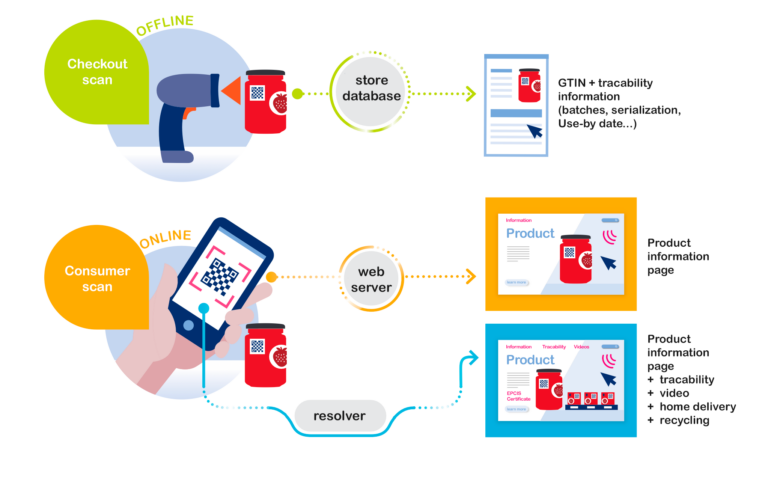
What happens: a QR code built in the right format contains your GTIN (your product’s worldwide number). The till identifies the product from it; the customer finds everything else.
Worth remembering: one QR code can do both. Better to place it in the right format from the start.
“My retailer wants my product data”
Weight, dimensions, composition, certificates: every chain asks, each in its own way.
What happens: the same QR code can serve a data sheet to retailer systems, without changing anything the public sees. Everyone scans the same QR code and receives what concerns them.
Worth remembering: the QR code answers professionals and customers, each in their own lane.
“I want to know whether any of this gets scanned”
Printing a QR code without knowing whether it works is pointless.
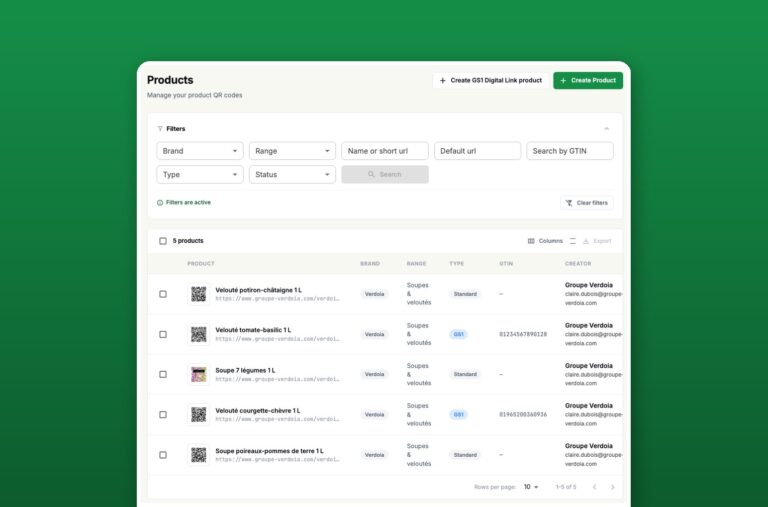
What happens: every scan is counted, by product, by country, by day. You see what works, where, and when. Your analytics read in two minutes, no training.
Worth remembering: print, then measure and adjust.
The same mechanics behind all ten
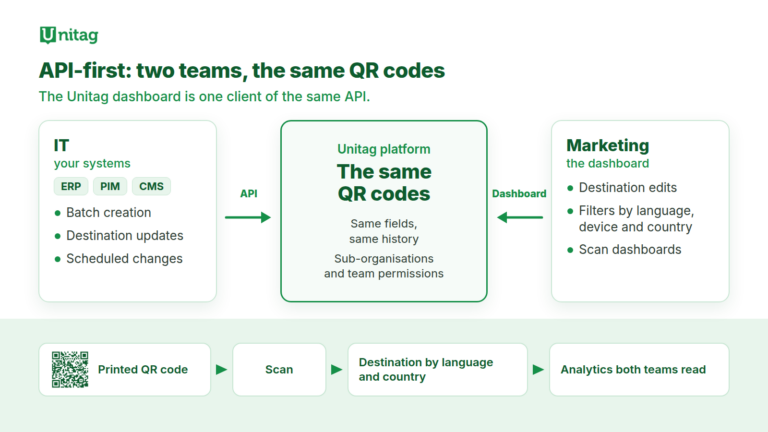
It is always the same QR code. Printed once, managed from a screen, changed whenever you want. Ten situations do not need ten tools; they need one QR code built properly from the start.
Creating the first one takes ten minutes, with the product numbers you already own. And if you would rather walk through your case with someone, tell us about your product.
Read next
- GS1 resolver: one printed QR code for Sunrise 2027 and the Digital Product Passport
- GS1 Digital Link resolver: the practical guide
- GS1 link types explained in plain language