GS1 Digital Link explained: the QR code that replaces the barcode
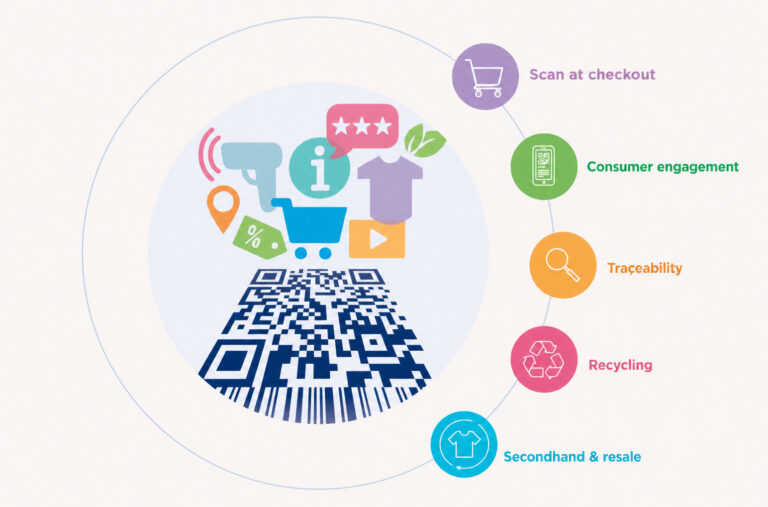
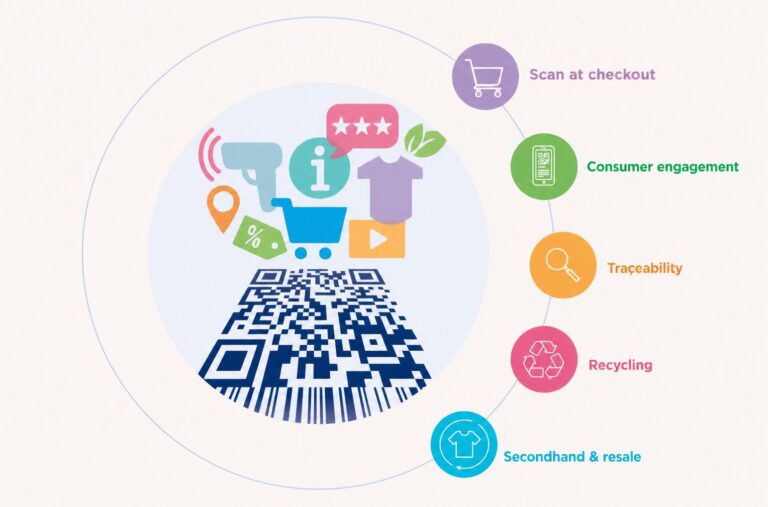
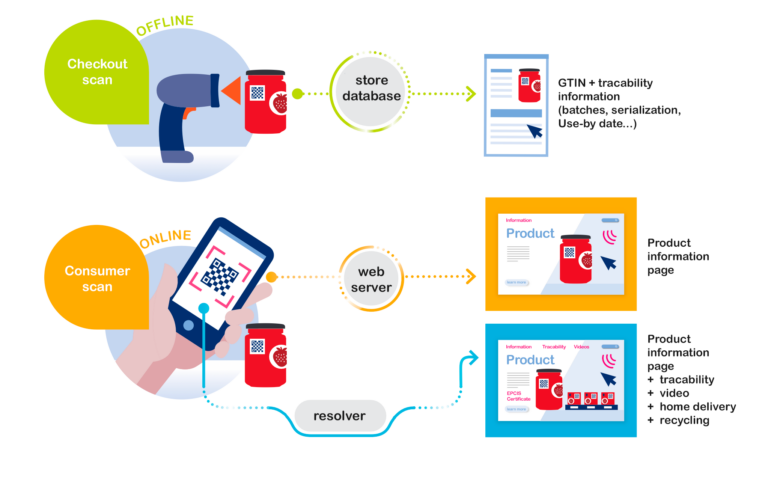
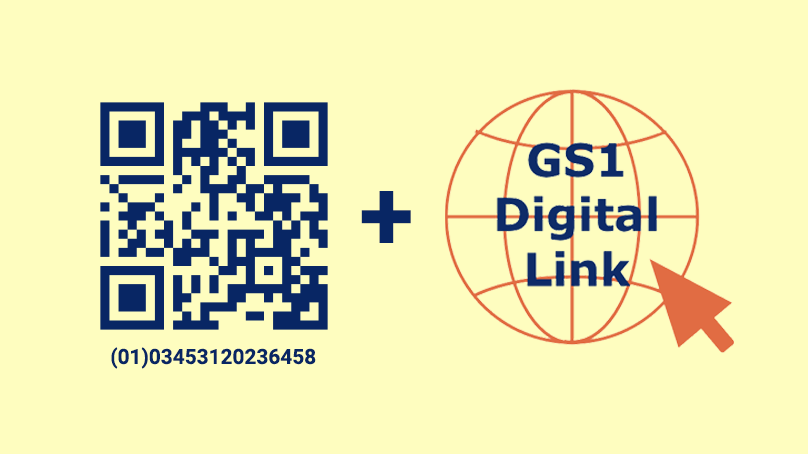
GS1 Digital Link is the URL standard that lets a QR code take on the functions of the EAN-13 barcode. GS1 and major retailers including Walmart, Carrefour and Tesco have set end-2027 as the target date for accepting the GS1 Digital Link QR code alongside the traditional barcode at checkout. The same QR code reads at the till as a GTIN, opens a product page on a consumer smartphone, and carries batch or serial data for traceability.
Unitag tracks 2.4 million scans daily across 189 countries. Over 40 million QR codes generated for brands including Bonduelle, Schneider Electric and L’Oréal.
What GS1 Digital Link actually is
A standard QR code can contain any URL. There is no convention about what that URL means, so a retailer’s checkout scanner cannot extract anything useful from it. GS1 Digital Link is the convention. It defines a URL pattern, maintained by GS1, that embeds the product’s GTIN and optional identifiers like batch, lot, serial number or expiry directly inside the URL. Any system that follows the GS1 specification can read those values from the URL, including a retailer’s point of sale.
The standard is maintained by GS1, the international standards body that has managed the EAN/UPC barcode since the 1970s. The Digital Link specification was first published in 2018.
How it differs from a standard QR code
A standard QR code routes a scan to a single destination. The destination is whatever URL you encoded, for example a marketing page or a PDF. If you need different content for different audiences, you have to manage that outside the QR code itself, with separate QR codes or with a redirect service.
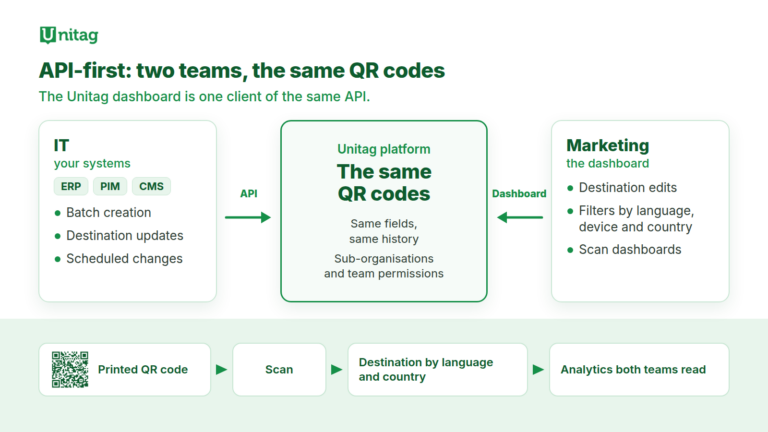
A GS1 Digital Link QR code works differently. The URL contains the product identity, and the resolver (the server that handles the scan) decides what to serve based on context. A consumer’s smartphone gets the product page. A retailer’s point of sale reads the GTIN. A logistics scanner reads the batch number. The published identifier is the GTIN itself, so brands can change the content layer without reprinting the QR code.
What a GS1 Digital Link URL looks like
Here is a worked example:
https://id.unitag.io/01/05012345678900/10/LOT26AThe URL breaks down as follows. https://id.unitag.io is the resolver domain, owned by the platform managing the QR code. /01/05012345678900 is application identifier 01 followed by the GTIN. /10/LOT26A is application identifier 10 followed by the batch number. The application identifiers come from GS1’s General Specifications. The path is fully specified, which is what makes the URL machine-readable in a way a regular short link is not. For qualifier order, query-string attributes and 14-digit padding, see the full GS1 Digital Link URI grammar.
Why retailers and regulators are pushing this now
Two pressures converge in 2027. The first is GS1 Sunrise 2027, the coordinated migration from 1D barcodes to 2D codes at retail point of sale. Major grocery and pharmacy retailers in North America and Europe have published acceptance timelines and are running pilot programmes with their largest suppliers.
The second pressure is regulatory. The EU Digital Product Passport, defined under the ESPR framework (Ecodesign for Sustainable Products Regulation, 2024/1781), requires certain product categories to carry a data carrier linking to compliance and sustainability information. Batteries come first (battery passport from February 2027 under EU 2023/1542); textiles follow, with a delegated act announced for 2027. Food is outside the ESPR, electronics sits in the Commission’s working plan around 2029, and cosmetics is not listed at this stage. GS1 Digital Link is the carrier many working groups favour, because a single QR code can satisfy the retail requirement and the regulatory one at the same time.
What it means for your packaging
For a brand managing its own packaging, the shift introduces operational changes on both the artwork side and the back-office side. The QR code has to be sized to scan reliably under retail lighting, and the print substrate has to hold contrast. Paperboard, plastic film and self-adhesive labels each behave differently; a QR code that scans on a sample card can fail on a glossy pouch.
The back-office side is less visible but matters more over time. Each GTIN needs a stable URL behind it, so the resolver and the QR code generator have to be the same managed system, or kept in sync through GS1-compliant APIs. Brands that try to maintain two separate systems for “the QR code” and “what the QR code points to” tend to lose track of either the URL mapping (which GTIN points to which URL) or the print version after the first few hundred SKUs.
How to start with GS1 Digital Link
The first prerequisite is a GS1 Company Prefix. If you already sell at retail with EAN or UPC barcodes, you have one and it is the same prefix you will use for Digital Link. The second is a certified resolver. Unitag’s Digital Link Resolver is the managed service we run for the food and industrial brands described on our GS1 Digital Link page, and Unitag is referenced as a GS1 Solution Provider Partner. The third is the artwork update, which most brands underestimate. Print files and dielines both need the new QR code position checked before the next production batch.
Most teams start with five to ten reference SKUs, dual-code them with the 1D barcode and the 2D code on the same pack, and validate retail POS reads through their retailer contact. From there, the rollout follows the regular packaging refresh cycle and the GS1 Digital Link pillar page covers the deeper specification questions teams come back to during scale-up.
Start with Unitag’s Digital Link Resolver
Our GS1-compliant resolver. Create, manage and track GS1 Digital Link QR codes with no per-code fees.
Related articles
- GS1 Digital Link vs QR code: what brands and printers need to know before Sunrise 2027
- QR codes on packaging: the complete guide for 2026
- Why brands choose Unitag for the GS1 QR code transition