
GS1 Digital Link:
the enterprise guide
One QR Code on the pack, scannable at the checkout and by the consumer, ready for the EU Digital Product Passport and the GS1 Sunrise 2027 transition. This page covers what the standard does, why it matters for your brand, and how Unitag helps you put it on packaging.
2027
GS1 Sunrise
Since 2013
Building QR Codes for brands
GS1
Certified by GS1
189
Countries served
In this guide
What is GS1 Digital Link?
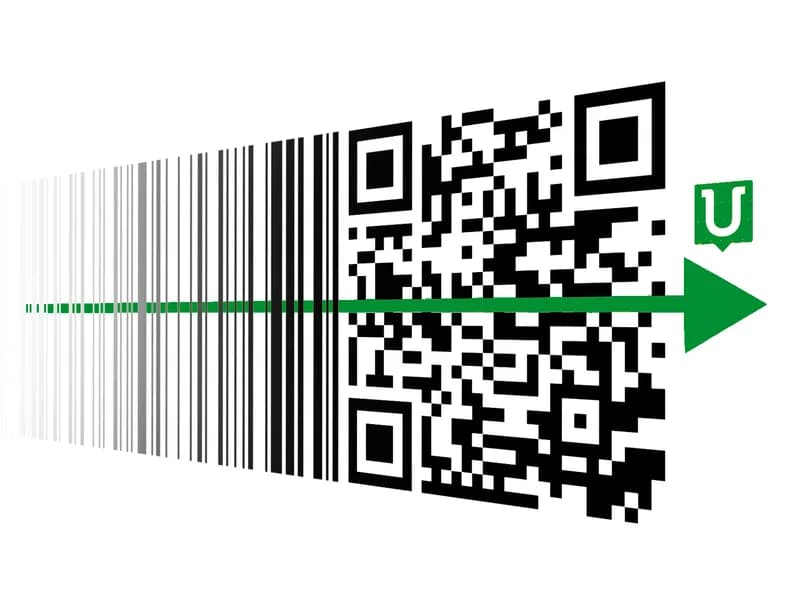
GS1 Digital Link is a global standard that embeds a web URI (a URL) inside a QR Code or other data carrier. A traditional EAN/UPC barcode only carries a product identifier (a GTIN). A GS1 Digital Link QR Code carries the GTIN and a resolvable URL, so the same QR Code that retail checkout uses to read the product can also open a webpage when a consumer scans it. In the UK, GS1 UK calls this a "QR code powered by GS1".
That makes the QR Code on the pack usable for two jobs at once: it works at the retail register the way a barcode does today, and it works as a consumer destination on a phone. The page the consumer reaches can change by market or by campaign without reprinting the packaging.
What is actually in the code
A traditional barcode encodes a GTIN, for example 05012345678901. A GS1 Digital Link QR Code encodes the same GTIN inside a URL such as https://id.your-domain.com/01/05012345678901, and can optionally include batch and serial. Retail scanners read the GTIN, consumer phones open the URL.
Why it matters for your brand
The move toward GS1 Digital Link is driven by two things at once: the GS1 Sunrise 2027 ambition to make retail scanners 2D-capable, and a wave of EU regulation (Digital Product Passport, wine, batteries, textiles) that requires a data carrier on pack. Once a brand has a GS1 Digital Link QR Code on the packaging, the same code does five distinct jobs across the product lifecycle:
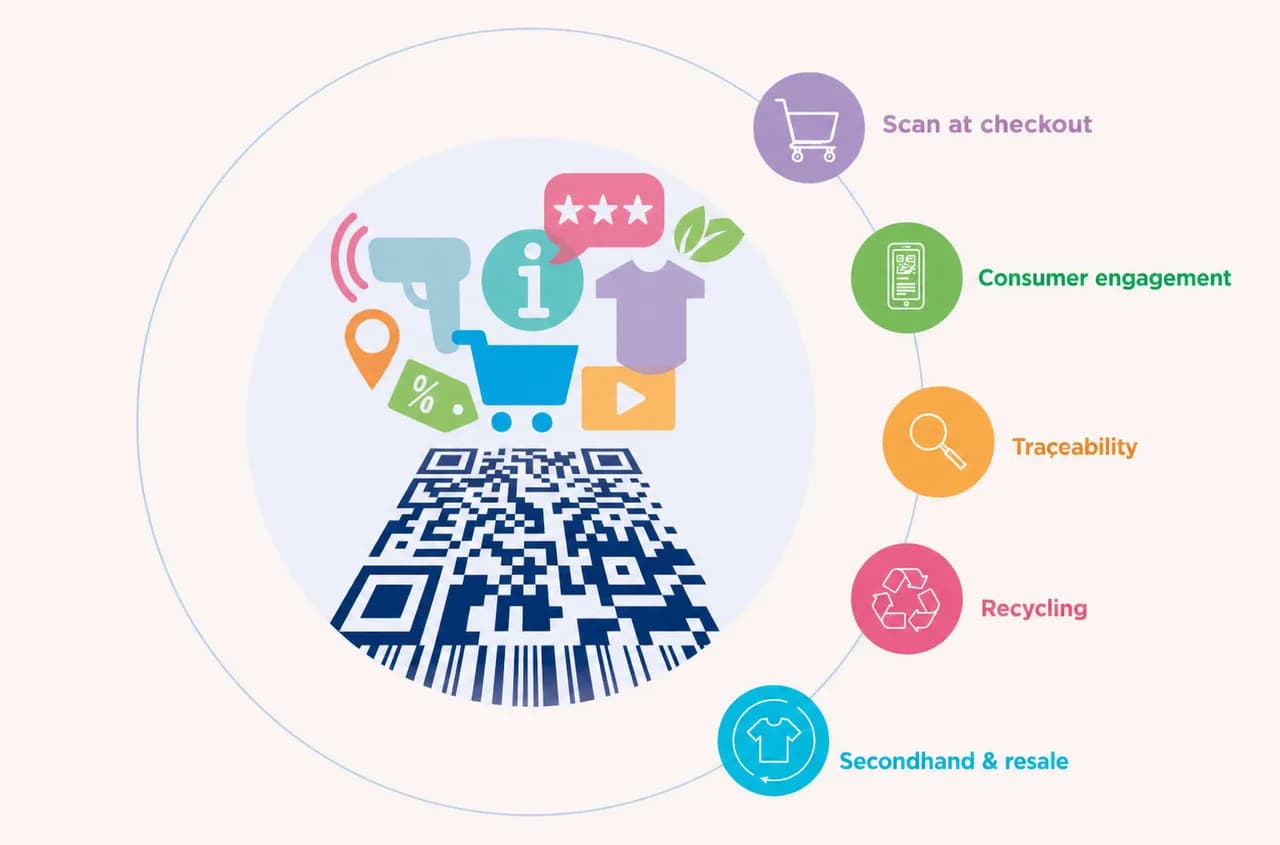
One GS1 Digital Link QR Code, five jobs done across the product's lifecycle.
- Scan at checkout: The same QR Code works through a retail POS system as a barcode replacement.
- Consumer engagement: The pack itself becomes a direct destination for the consumer, with no app to download.
- Traceability: The brand gets visibility from factory to shelf to consumer scan, so it sees where products end up in real use rather than only where they were shipped.
- Recycling: The code routes to material composition, sorting instructions, and end-of-life information for circular-economy compliance.
- Secondhand and resale: Authenticated provenance for resale platforms and brand-owned secondhand programs.
The operational benefit underneath all five is the same: the content behind the URL can be updated without reprinting the label. Recalls, promotions, allergen updates, compliance pages, language additions, all happen at the resolver layer rather than in the print queue. The brand also gets first-party scan data (country, device, time, language) that retail POS data on its own does not provide.
GS1 Digital Link vs traditional barcodes
| Feature | Traditional Barcode (EAN/UPC) | GS1 Digital Link QR Code |
|---|---|---|
| Data capacity | 13-14 digits (GTIN only) | Practically unbounded for typical Digital Link URIs (QR Code spec caps at ~4,296 alphanumeric characters) |
| Consumer interaction | None | Full web experience on scan |
| Content updates | Requires reprint | Updateable at any time via the resolver |
| Analytics | POS data only | Scan-level: location, device, time, language |
| Checkout compatible | Yes | Yes (when properly formatted) |
| Regulatory compliance | Current retail standard | Required for DPP, wine, batteries; expected at retail from 2027 |
| Supply chain traceability | Limited | Full serialization support |
| Multi-market support | One barcode, one meaning | One code, content adapts by country/language |
GS1 Sunrise 2027
GS1, the global standards organization behind barcodes, has set an industry ambition called Sunrise 2027: by the end of 2027, retailers around the world should be able to scan 2D codes at point of sale. The old 1D barcode is not deleted overnight. What changes is that retailers commit to accepting a 2D code (typically a GS1 Digital Link QR Code) as a valid checkout symbol, which lets brands consolidate the regulatory and consumer use cases into a single mark on the pack.
The commitment is set out in GS1's global industry endorsement statement, signed by manufacturers and retailers, which states that retailers operating to GS1 standards "must begin accepting QR Codes with GS1 Digital Link at point-of-sale by the end of 2027." That is the line of accountability brands can plan against.
Retailer adoption so far
The retailer side of Sunrise 2027 is already visible in market. Walmart in the US, Carrefour in France, Tesco in the UK and Woolworths in Australia and New Zealand have all run GS1 Digital Link pilots on selected categories. Lidl across Europe has used the standard on fresh produce, with country of origin and farm-level data exposed via the consumer-facing URL. GS1 UK reports that 11% of its 60,000-member base is live on GS1 Digital Link as of early 2026, with another 33% planning a rollout in the next twelve months. According to GS1's own tracking, 48 countries representing 88% of world GDP have retailers piloting acceptance at point of sale.
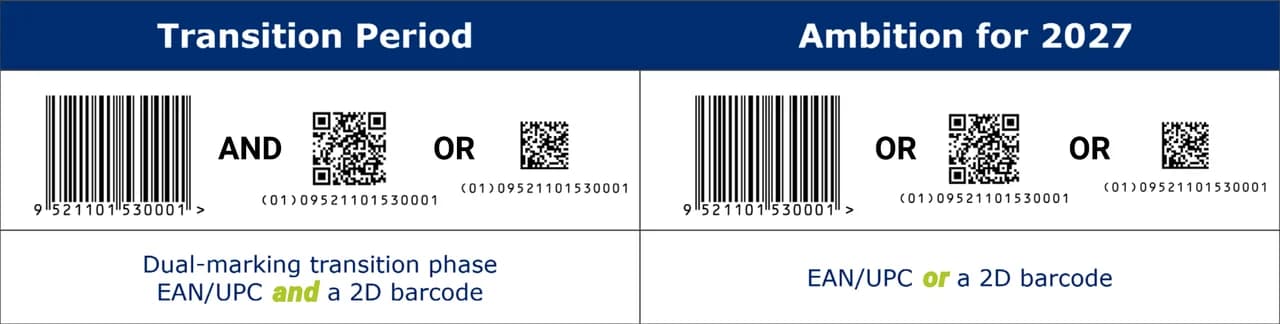
The GS1 transition: dual-marking now, single 2D code by 2027.
What this means in practice
The Sunrise 2027 ambition is about retailer scanner capability rather than the end of EAN/UPC. In practice it means that from end-2027, brands can run a single 2D code on pack that handles checkout and the consumer experience together, while keeping full scan compatibility at the register. Adoption pace varies by retailer and region. Brands piloting now use a dual-marking period, with both the legacy barcode and a GS1 Digital Link QR Code on the same pack.
Timeline for brands
- Now – end of 2026: Pilot GS1 Digital Link on a defined SKU subset. Agree the resolver setup with the GS1 Member Organization in your country, and check accepted symbologies with retail partners.
- 2027: Retail systems become 2D-capable in line with the Sunrise ambition. Dual-marking is the practical norm on most packs.
- 2028 onwards: Where retailer scanners and supply chain allow, brands can run a single 2D code as the primary mark. Legacy barcodes remain valid where retailers still require them.
EU Digital Product Passport
The European Union is introducing the Digital Product Passport (DPP) as part of its Ecodesign for Sustainable Products Regulation (ESPR). The DPP requires that certain product categories carry a data carrier, typically a QR Code, linking to comprehensive product information: materials, origin, recyclability, carbon footprint and repair instructions.
GS1 Digital Link is the natural vehicle for the DPP. A single GS1 Digital Link QR Code on the product can serve both the regulatory passport and the consumer-facing experience, which avoids running two parallel data carriers on the same pack.
Affected sectors (first wave)
- Batteries: DPP required from February 2027 under Regulation (EU) 2023/1542.
- Textiles and apparel: DPP requirements expected 2027-2028 under the ESPR delegated act.
- Toys: Listed in the first ESPR priority batch; data requirements being defined.
- Detergents: Listed in the first ESPR priority batch.
- Electronics: In scope under ESPR. Delegated act pending.
- Food and beverage: Nutritional and allergen information via QR Code is already active for wine under EU Regulation 2021/2117. Other food categories are not currently in scope for ESPR DPP.
Cosmetics is not on the first ESPR priority list. Cosmetics brands operating in the EU should track the CSAR (Cosmetics Products Regulation) digital labeling discussions separately, and in the US the MoCRA registration data carrier work, neither of which is technically a DPP but both of which fit comfortably on a GS1 Digital Link QR Code.
What each DPP actually requires
The data set varies by category. Brands rolling out GS1 Digital Link for compliance should know what their DPP will actually need to expose, because the resolver setup follows from the data spec.
Battery passport (Annex XIII of Regulation 2023/1542). Lifecycle greenhouse-gas emissions, performance class, expected service life, nominal voltage, rated capacity, depth of discharge, and percentage of recycled cobalt, lithium, nickel and lead. The Battery Regulation uses tiered access, so the same GS1 Digital Link QR Code exposes a public layer to consumers, a wider data set to professionals such as repairers and recyclers, and the full record to market surveillance authorities under role-based access control.
Textiles DPP (under ESPR delegated act). Fiber composition by weight, country of last substantial processing, recycled content percentage, microplastic shedding indicators, repair and recycling instructions, and the supply chain footprint. Tiered access is expected to follow the same pattern as batteries.
Wine e-label (EU Regulation 2021/2117, in force since December 2023). Different model and intentionally narrow. The QR Code can carry only the ingredients list and the nutrition declaration. Marketing content is explicitly forbidden behind the e-label. User tracking is restricted: GS1 Digital Link still works as the data carrier, but scan analytics on the regulated landing must respect the no-marketing constraint.
See the Unitag Wine Label solution →
See how Unitag handles GDPR compliance and EU data residency →
The takeaway for the resolver setup: each sector exposes a different data shape, and at least the battery and textiles passports will route different scanners to different views of the same code. The brand's job is to map the data fields once, then let the resolver enforce who sees what.
How it works (technical overview)
A GS1 Digital Link URI follows a standardized structure:
https://your-domain.com/01/05012345678901/10/BATCH123/21/SERIAL456- /01/ GTIN (Global Trade Item Number)
- /10/ Batch or lot number
- /21/ Serial number (for unit-level traceability)
When this URI is encoded into a QR Code, it becomes scannable at checkout (the POS system reads the GTIN) and by consumers (the browser opens the URL and displays the product experience).
Unitag's platform handles the resolution layer. When a consumer scans the QR Code, Unitag identifies country, language and device, then serves the right destination for that scan: a recipe page in French for one market, a regulatory compliance page in German for another, and so on. The same printed code, different pages.
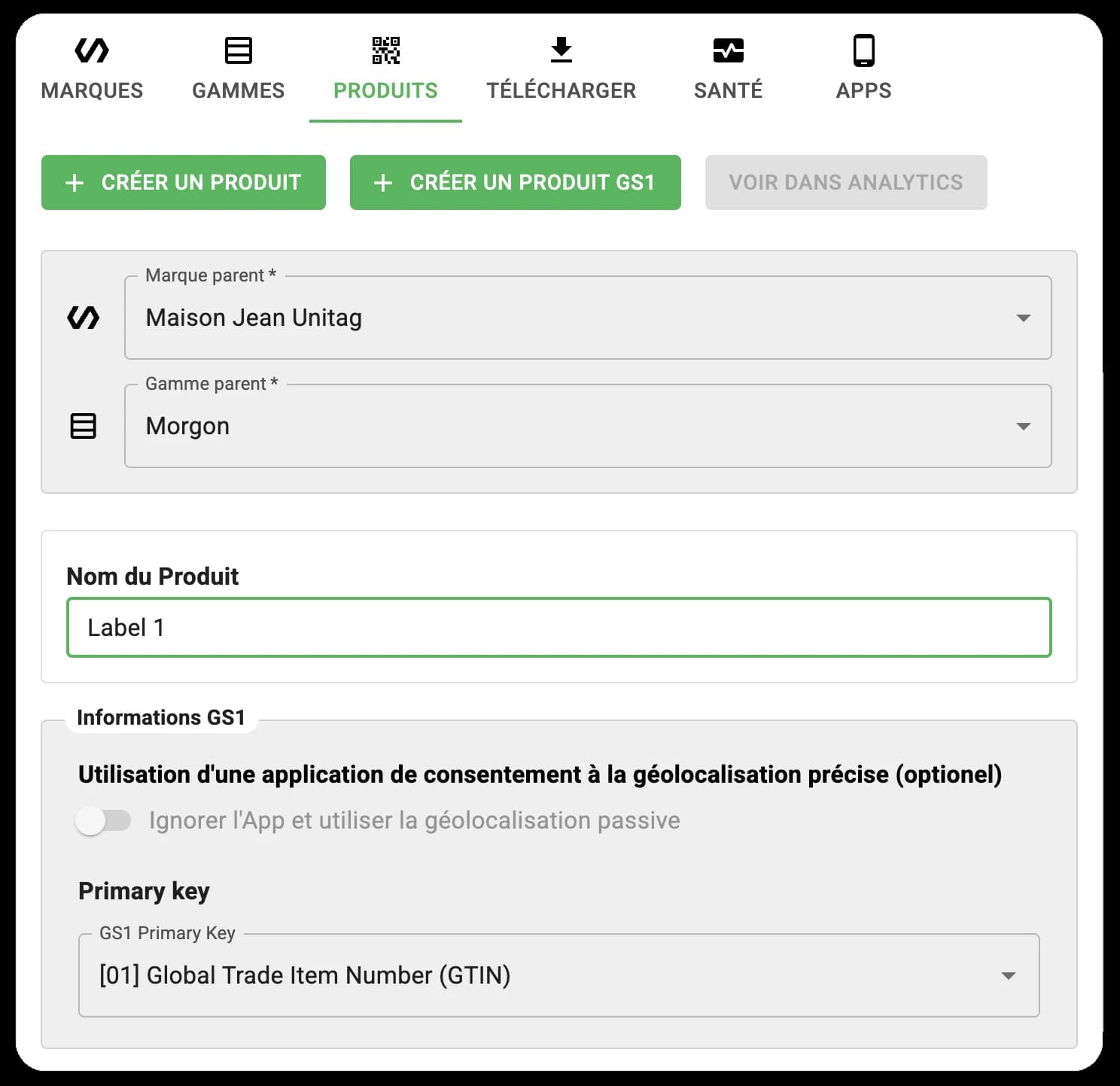
Creating a GS1-compliant product in the Unitag console takes under a minute. The GTIN becomes the primary key, the resolver routes scans by country and device.
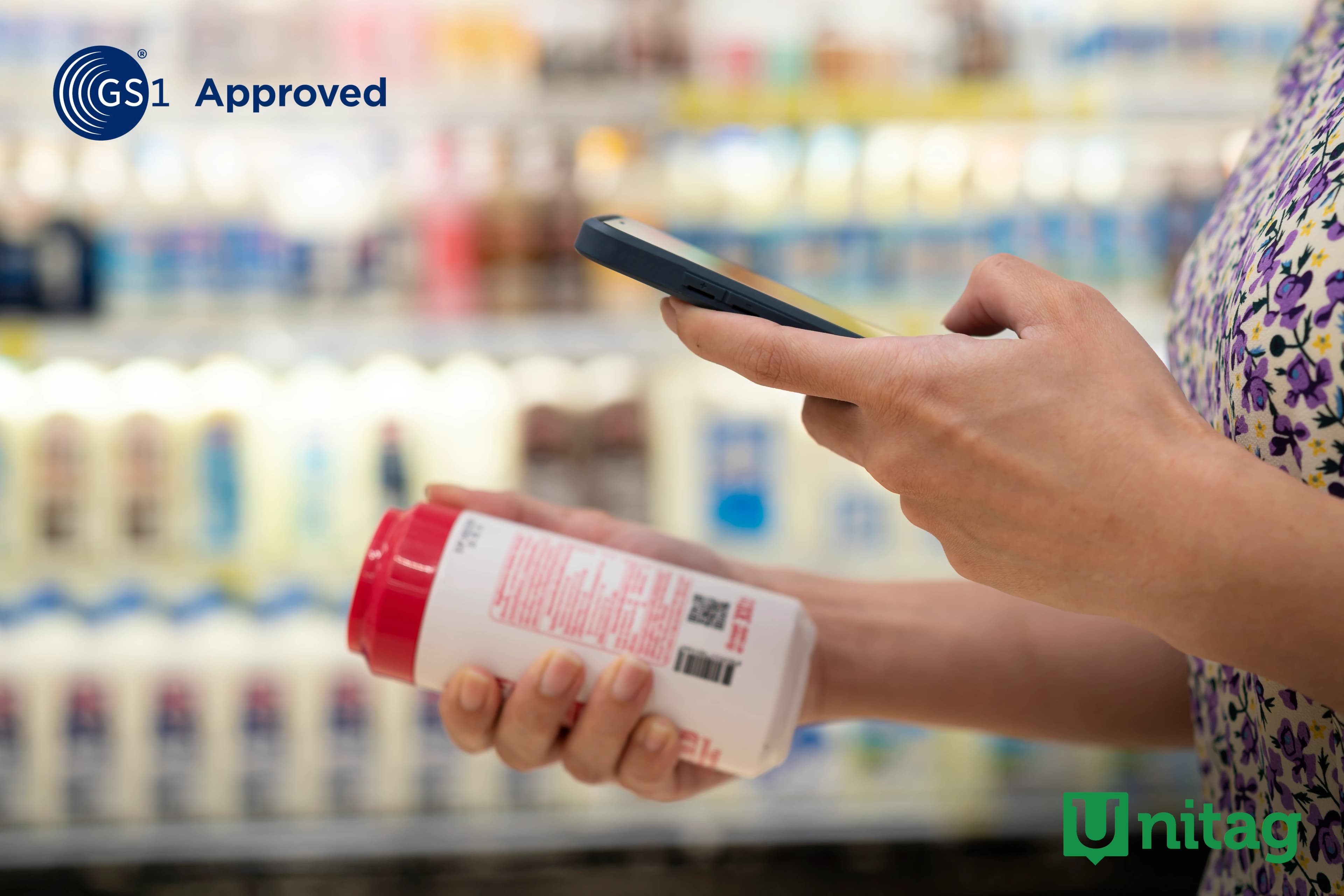
The consumer-facing layer: a single scan opens the brand's digital experience, in the right language, on any phone.
Why Unitag for GS1
Unitag is certified by GS1 for its Digital Link Resolver: the tool passed GS1 France qualification on the GS1 Digital Link URI structure and the QR Code symbol. Unitag is also listed as a Solution Provider by GS1 France. Headquartered in the UK with a France-based subsidiary, Unitag has built QR Code infrastructure for brands since 2013. We work with reference clients including Chanel and Barnes International, and run packaging programs across 189 countries.
- Certified by GS1: QR Codes created on the dashboard follow the GS1 Digital Link syntax and the GTIN allocation model out of the box.
- Packaging dashboard: Manage QR Codes by brand, range and SKU. Create, update and monitor codes in batch from a single console.
- Routing by country, language and device: The same printed code resolves to different destinations depending on where it is scanned. All configuration lives on the resolver, so changes do not affect the printed packaging.
- Scan analytics: Scan-level data with country, device, time and language. Exportable to Excel and connectable by API.
- QR Code healthcheck: Automated monitoring of destination URLs, with alerts if a target goes down. Designed to protect printed packaging runs.
- EU hosting, GDPR-compliant: Data hosted in the EU. Enterprise SSO and contractual SLA available on Diamond.
How many products need GS1 Digital Link QR Codes?
This helps us point you to the right solution.
1 to 600 products
Wineries, artisan brands, independent cosmetics, regional food. Self-serve Digital Link plans with GS1-compliant 2D barcodes, country routing, language routing and scan analytics.
Small €12 · Medium €25 · Large €49 · up to 600 GTINs
Self-serve. 14-day free trial. No demo needed.
600+ products or multi-market
CPG brands, manufacturers, pharma. Full Diamond Packaging dashboard, with batch code generation, sub-organizations for governance, and a contractual SLA.
Dedicated onboarding · Enterprise SLA · SSO
Our team walks you through it.
Implementation FAQ
Detail for teams scoping a GS1 Digital Link rollout. Tap a question to expand the answer.
The GS1 Digital Link URI accepts the full application identifier (AI) set as path segments, with one primary key followed by any qualifiers and attributes relevant to that key. In practice the keys brands use most often on packaging are: • /01/ GTIN (the primary key in most consumer-goods cases). • /10/ Batch or lot number. • /21/ Serial number (for unit-level traceability and anti-counterfeit). • /11/ Production date (YYMMDD). • /17/ Expiry or best-before date (YYMMDD). • /22/ Consumer product variant (CPV), used when color or flavor varies under the same GTIN. • /414/ GLN (Global Location Number), useful for routing scans by site of production. • /8003/ GRAI (Global Returnable Asset Identifier) for reusable assets. • /422/ Country of origin. • /3103/ Net weight in kilograms. The full reference is published at ref.gs1.org/standards/digital-link/uri-syntax/. The Unitag console exposes the most common ten by default and adds the rest on request for Diamond plans.
The brand owner is expected to run its own resolver on its own domain. GS1's official guidance describes id.gs1.org as the "resolver of last resort" rather than the production path. Hosting on your own domain (or on a Unitag-managed resolver subdomain such as id.your-brand.com) keeps the URL short, on-brand, and under your control, which matters for trust on the consumer scan and for analytics ownership. The technical bar is the GS1 Conformant Resolver specification. The resolver has to respond correctly to the URI syntax, support link-set responses for multiple destinations from the same GTIN, and handle redirection by language, region and context. Unitag operates a GS1-conformant resolver out of the box, and can map it to a custom domain on Diamond. A short URL also matters for printed pack readability. id.brand.com/01/05012345678901 is shorter than the GS1 fallback URL, so the QR Code can encode at a higher error-correction level inside the same module size.
For point-of-sale scanning, GS1 specifies an X-dimension (module size) between 0.396mm and 0.990mm. The practical floor on most flexible and folding-carton packaging is a 15×15mm code; curved surfaces such as bottles and cans typically need 20×20mm or larger to maintain scanner reliability. Error-correction level H (around 30% of the code recoverable from damage) is recommended for printed packaging. The four-module quiet zone around the code is mandatory: anything less and POS scanners reject the read. Substrate matters. Matte paper and folding cartons print cleanly. Thin film, foil, glass and curved metal substrates need higher contrast, larger module sizes or laser etching rather than ink. The Unitag QR Code healthcheck runs print-quality verification at first scan, so artwork problems are caught before they cost a print run.
Several misconceptions come up regularly with brand teams scoping a rollout. Worth clearing them up. • It is not "any QR Code pointing at a product page." A regular branded QR Code routing to a marketing landing page is not GS1 Digital Link. The standard requires the URI to follow GS1 syntax with a recognized primary key. • The QR Code does not "store" video, documents or product imagery. The QR Code stores a URL. The destination behind that URL stores the content, and the resolver decides which destination each scan reaches. • GS1 Digital Link is not a new symbology. The QR Code itself is the standard ISO/IEC 18004 QR. What changes is the URI encoded inside it. Existing QR scanners and consumer phone cameras already read it. • GS1 DataMatrix is a separate carrier, not GS1 Digital Link. DataMatrix uses element-string syntax (FNC1-delimited). It is the dominant carrier in pharma and remains valid for many regulated categories. The Digital Link URI syntax is supported in QR Code, DataMatrix and a few other 2D carriers, but they are not the same thing operationally. • Implementing GS1 Digital Link does not give you a Digital Product Passport. The DPP is the regulatory data layer. GS1 Digital Link is the data carrier that makes the DPP scannable on pack. You need both.
A standard GS1 Digital Link QR Code is identification, not authentication. Anyone can scan and read the code, and a photocopy of the pack reproduces the same URL. For categories where counterfeit is a real exposure (luxury, premium spirits, cosmetics, pharma, electronics accessories), the GS1 Digital Link code is paired with a serial number (the /21/ qualifier) and a secure copy-detection layer. Unitag works with PiQR on this layer. The secure graphic prints inside the same QR Code module pattern and carries high information density that degrades on any reprint or photocopy. At scan time, the Unitag resolver verifies the secure graphic alongside the GTIN and serial, then returns either an authenticated response or an alert if the code is a copy. Each scan becomes an authentication event with country, language, device and time, which means brands also get a counterfeit-distribution map as a by-product of normal consumer scans. For brands already running serialized GS1 Digital Link, adding the PiQR layer is an artwork-level change on the next print run rather than a rebuild of the resolver. Scoped on Diamond.